Travel guide
If you're a US citizen, you don't need an eTA or a visa to visit Canada. US green card holders are also exempt. Here's what you do need, and who actually has to apply.
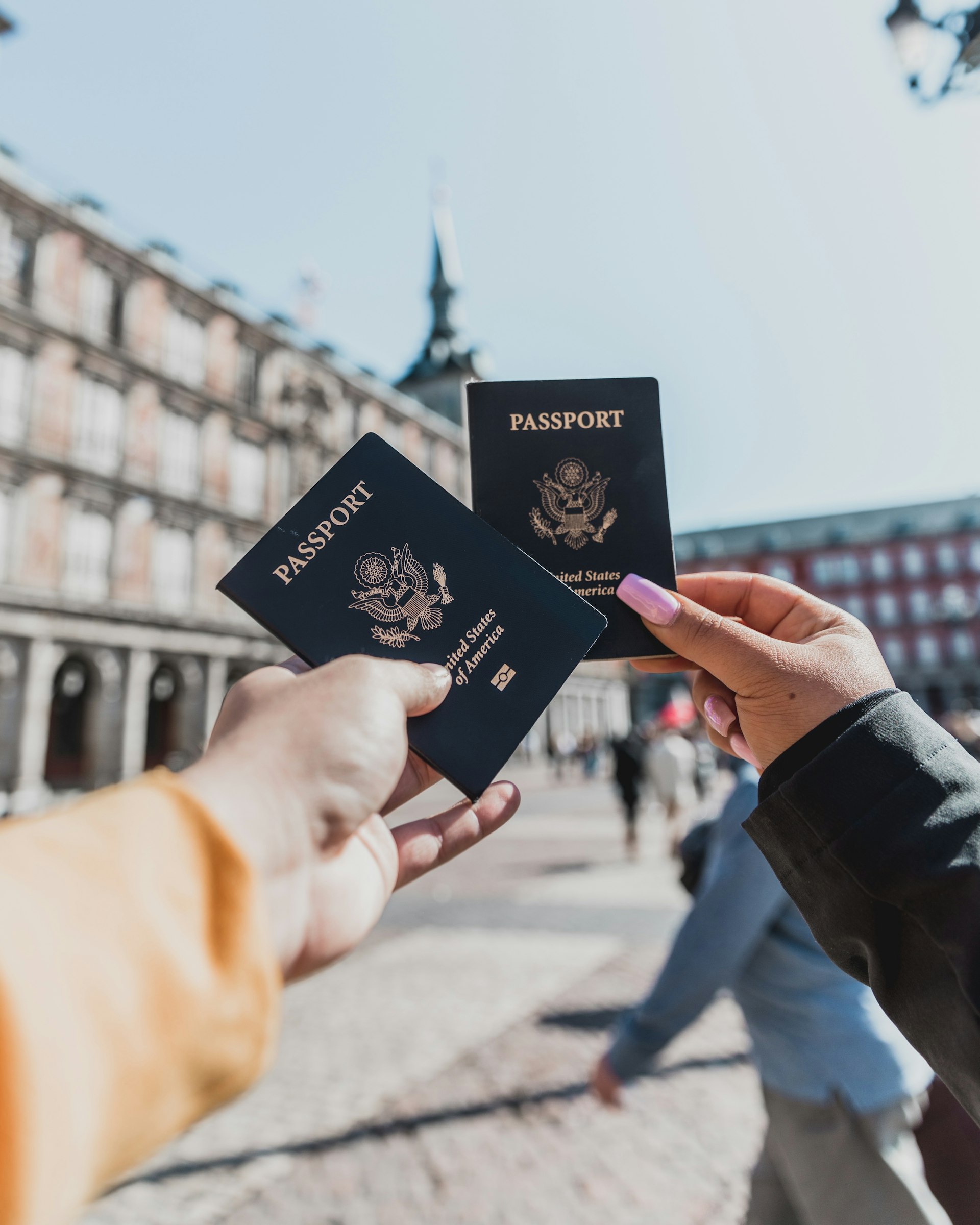
Two US passports held up in a European city square, Toronto
Next: the trip itself
Fly2Any travel brief
When to book, airport tricks, document changes and how to plan the whole trip. No fake fare alerts.
If you're a US citizen, you are exempt from the eTA requirement. You must carry proper identification such as a valid US passport.[2]
If you're a lawful permanent resident of the United States (a green card holder), you're also exempt from the eTA requirement. That exemption has applied since April 26, 2022.[2]
An eTA, short for electronic travel authorization, is an online permission to board a flight to Canada. It's for citizens of certain countries who don't need a visitor visa. It costs CAN$7 and is not a visa.[1],[2]
The eTA is for citizens of eTA-required countries or territories. If you're a citizen of one of those places and you're flying to Canada, you need an eTA and a valid passport to board your flight, and you do not need a visitor visa.[2],[4]
If you're a citizen of an eTA-required country and you arrive by car, bus, train or boat (including a cruise ship), in most cases you do not need an eTA to enter Canada, but you still need a valid passport.[2],[4]
There's one sea exception: if you travel by sea from Saint-Pierre-et-Miquelon, excluding cruise ships, you need an eTA to board your boat.[2],[4]
Some travelers from visa-required countries may be eligible to apply for an eTA instead of a visitor visa if they're flying to Canada and meet certain requirements. Citizens of Indonesia and Malaysia who meet certain requirements may be eligible as of May 26, 2026. But if those travelers arrive by car, bus, train or boat, including a cruise ship, they still need a visitor visa, not an eTA.[2],[3],[4]
A few groups are outside the eTA system entirely. Canadian travellers don't need a visa or an eTA to enter Canada. Canadian permanent residents don't need an eTA or a visitor visa, but they must travel with a valid permanent resident card or permanent resident travel document.
An eTA costs CAN$7. The fee is non-refundable.[1],[3]
You can pay with Visa, Mastercard or American Express, including pre-paid cards from those brands. Visa Debit and Debit Mastercard also work, as do UnionPay and JCB cards.[3]
If you're in a group that needs an eTA, here's the document list. Get everything ready before you open the form.[3]
Check you're eligible
Confirm you're a citizen of an eTA-required country or territory and that you're flying to Canada. If you're a US citizen or US green card holder, you don't need this at all.[2]
Fill in the online form
The eTA application is made using the online form. The form is only available in English and French, and it cannot be saved, so have your information ready before you start.[3]
Most eTA applications are approved within minutes. That's the typical case, not a guarantee.[3]
Some applications need more. You may need to submit documents before your application can be approved, and if so, an email with instructions will be sent within 72 hours.[3]
An eTA lets you board a flight to Canada. It is not a visa, and you need one or the other, not both.[2]
An eTA does not guarantee entry to Canada. A border services officer will ask to see your passport and other documents when you arrive, and you must convince the officer that you are eligible for entry.[2]
To visit Canada, you need a valid travel document such as a passport, and a valid eTA or visitor visa. You must also be in good health and have no criminal or immigration-related convictions.[2]
You must convince a border services officer that you have ties, such as a job, home, financial assets or family, that will take you back to your home country or territory, and that you will leave Canada at the end of your visit. You must also have enough money for your stay; the amount varies depending on how long you stay and whether you stay in a hotel or with friends or relatives.[2]
A work permit or study permit is not a visa. In most cases, workers and students will also need a valid visitor visa or an eTA to enter Canada. If you're applying for your first study or work permit and need a visa or an eTA, it will be issued automatically once your application is approved.[4]
US citizens should carry proper identification such as a valid US passport. If you don't have a valid passport and you aren't traveling by air, you can present identity documents showing your full name, date of birth and citizenship, or a combination of documents if one doesn't include all of that information.[2],[4]
US lawful permanent residents traveling to Canada by air must bring a valid passport from their country of nationality (or an equivalent acceptable travel document) and a valid permanent resident (green) card or equivalent valid proof of status in the US.[2],[4]
US permanent residents entering Canada by land or water directly from the US or Saint-Pierre-et-Miquelon only need to provide their valid permanent resident (green) card or equivalent valid proof of status in the US, and don't need to provide their passport.[4]
Acceptable proof of US lawful permanent resident status includes a valid permanent resident card (Form I-551), a foreign passport with an unexpired temporary I-551 stamp (ADIT stamp), a foreign passport with a temporary I-551 printed notation on a machine-readable immigrant visa endorsed with a US Customs and Border Protection admission stamp, an expired permanent resident card (Form I-551) with Form I-797 for a pending Form I-751 or Form I-829, an expired permanent resident card (Form I-551) with Form I-797 for a pending Form I-90, a valid re-entry permit (Form I-327), or Form I-94 with an unexpired temporary I-551 stamp (ADIT stamp) and a passport-style photo.[2]
Involvement in criminal activity, human rights violations or organized crime can make you inadmissible to Canada. You can also be inadmissible for security, health or financial reasons.[2]
The CAN$7 fee is non-refundable, so check that you actually need an eTA before you pay. US citizens and US green card holders don't need one.[2],[3]
The application form can't be saved and is only in English and French. Have your passport, payment card and email address ready, and read the help document first, so you don't have to start over.[3]
If your application is pending or you're unsure of your status, you can check your eTA status online for updates and information on your current eTA.
No. US citizens are exempt from the eTA requirement and must carry proper identification such as a valid US passport. You also don't need a visitor visa.[2],[4]
No. As of April 26, 2022, lawful permanent residents of the United States are exempt from the eTA requirement. By air, bring a valid passport from your country of nationality (or an equivalent acceptable travel document) and a valid green card or equivalent proof of status.[2],[4]
In most cases, travelers from eTA-required countries arriving by car, bus, train or boat, including a cruise ship, do not need an eTA to enter Canada. You still need a valid passport.[2]
An eTA costs CAN$7, and the fee is non-refundable. Most applications are approved within minutes, though some require documents, in which case an email with instructions is sent within 72 hours.[3]
Some citizens of visa-required countries may be eligible to apply for an eTA instead of a visitor visa if they're traveling to Canada by air and meet certain requirements. Citizens of Indonesia and Malaysia who meet certain requirements may be eligible as of May 26, 2026. If you arrive by car, bus, train or boat, including a cruise ship, you still need a visitor visa.[2],[3]
No. Dual Canadian citizens need a Canadian passport rather than an eTA for travel to or through Canada. American-Canadians can travel with a valid Canadian or US passport, but if they use a US passport they'll need identification showing their Canadian citizenship.[1],[2],[4]
No. An eTA does not guarantee entry. A border services officer will ask to see your passport and other documents on arrival, and you must convince the officer that you are eligible for entry.[2]
Every rule, fee and deadline above is taken from these official pages, which we read on October 27, 2026. Rules change, so check the official page before you apply or pay.
Was this guide helpful?
Paperwork sorted?
Flights to Toronto
Real fares for your dates, with bag fees shown before you pay.
Been through this recently? Share what happened, a tip, or a question for other travelers.
No comments yet. Be the first to share your experience.
Visa-required travelers, including alien's passport holders and stateless individuals, do not need an eTA and must travel with a visitor visa. Stateless individuals and those with a refugee travel document also need a visa to visit or transit through Canada.[2],[4]
Good to know
Read the help document first
The Government of Canada advises getting your passport and payment card ready and reading the help document before you apply. It takes a few minutes and saves you from restarting a form you can't save.[3]
Pay the fee
Pay CAN$7 right after you complete the form. The fee is non-refundable.[3]
Watch your email
You get an email about your eTA application. If you need to submit documents, an email with instructions will be sent within 72 hours.[3]
Check your status if you need to
You can check your eTA status online to get updates on pending applications and information on the status of your current eTA.[1]
Dual Canadian citizens are a separate case. Most dual Canadian citizens need a Canadian passport to travel to or transit through Canada, and dual Canadian citizens must travel with a valid Canadian passport rather than an eTA. American-Canadians can travel with a valid Canadian or US passport; if they travel with a US passport, they'll need to carry identification that shows their Canadian citizenship.[1],[2],[4]
Canadian citizens need a valid Canadian passport to travel to Canada by air, and if traveling by land or sea they can use another identification document. Canadian permanent residents need a valid permanent resident card or permanent resident travel document when traveling to Canada by commercial vehicle (airplane, bus, boat or train). Traveling in a private vehicle, they can use their PR card or other documents to return to Canada; a private vehicle can be a car, truck, motorcycle or recreational vehicle that you own, borrow or rent.[4]
Minor children under 18 must meet the same entry requirements as any other traveler to Canada and may need to show additional documents depending on their situation.[4]