Travel guide
US citizens don't apply for the Entry/Exit System in advance — your fingerprints and photo are taken at the border. ETIAS is a separate online authorization, not yet in operation.
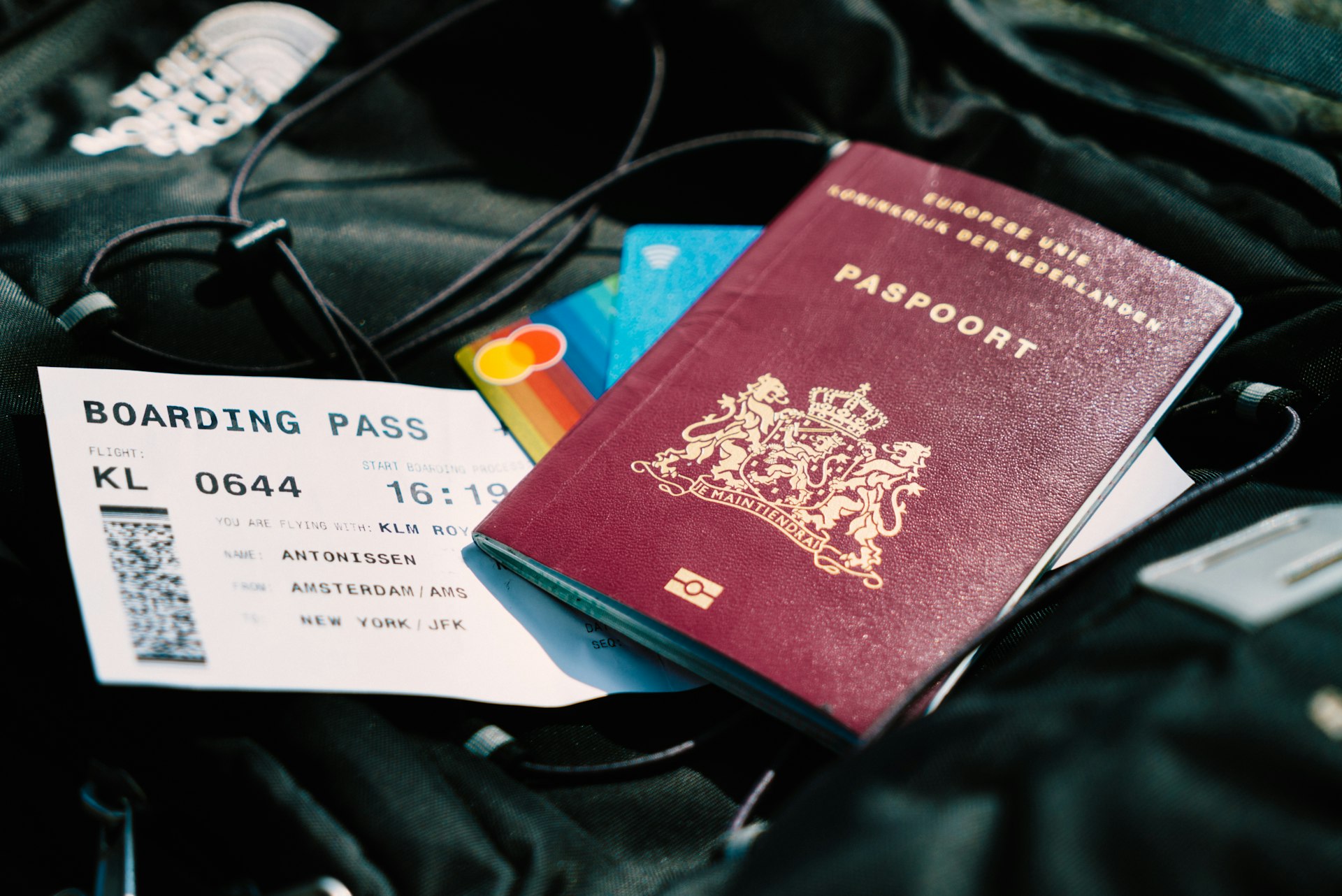
A passport and a boarding pass ready for a flight, Paris
Next: the trip itself
Fly2Any travel brief
When to book, airport tricks, document changes and how to plan the whole trip. No fake fare alerts.
If you're a US citizen heading to Europe for a short trip, you don't need to apply for anything called EES. The Entry/Exit System is an automated IT system that registers non-EU nationals travelling for a short stay each time they cross the external borders of 29 European countries. There's no form, no fee, and no advance application — your data is recorded when you arrive.[1],[3]
What you will notice is a change at the border itself. As of 10 April 2026, the EES replaces the stamping of passports. Instead of a stamp, your passport details, facial image and fingerprints are recorded electronically, along with the date and place you enter and exit.[1],[3]
There is a second system on the horizon called ETIAS, which is a travel authorisation for visa-exempt nationals. It is currently not in operation and no applications are being collected. So for now, a US passport is what you need — ETIAS comes later.[2],[5]
EES applies to non-EU nationals travelling for a short stay of up to 90 days within any 180-day period to 29 European countries. That includes US citizens. It doesn't matter whether you would normally need a visa or not — the system records short-stay travelers either way.[2],[3]
The EU gives a clear example: when a US citizen arrives at the external EU border, their personal data will be recorded in the EES. The same applies to travelers who need a visa, such as an Indian citizen on a short stay — their data is recorded too, even though they won't need ETIAS.[3]
So the practical answer is: if you're a US citizen on a short trip to Europe, you're in scope for EES. You don't opt in or sign up. It happens at the border.[1],[3]
There is no EES application fee because there is no EES application. Unlike ETIAS, travellers do not apply for EES in advance, so there's nothing to pay before you travel.[3]
The fee that does exist belongs to ETIAS, which is a separate system. The ETIAS travel authorisation fee will be EUR 20 instead of the previous EUR 7, and it will enter into effect as soon as ETIAS is operational, expected for the last quarter of 2026. Applicants under 18 or over 70 are exempt from paying the ETIAS fee.[4]
For EES itself, the main thing you need is your passport. Here's what gets recorded when you cross:[1]
For US citizens, there is no visa obligation for travel to these European countries, and a US passport is the document you present. ETIAS, when it starts, will be an additional online authorization — but it is not in operation yet.[2],[5]
Your photo and fingerprints are taken
A facial image is captured and fingerprints are collected at the border.[3]
EES started operations on 12 October 2025 and became fully operational on 10 April 2026. European countries are introducing it gradually at their external borders, with data collection rolled out at border crossing points and full implementation by 10 April 2026.[1],[3]
Because you don't apply in advance, there's no processing time to plan around. The only timing that matters is the 72-hour window if you choose to pre-register with the "Travel to Europe" app before you enter.[3]
The system you will need to plan around is ETIAS. It is scheduled to start in the last quarter of 2026, and the EU will confirm the exact start date later in 2026. Once it's live, you'll apply online before your trip.[3]
EES is a registration system, not a permission. It doesn't grant you entry or extend your stay — it records your crossings. What it does do is allow automatic detection of overstayers, meaning travellers who have exceeded the maximum duration of their authorised stay.[1]
It also helps identify travellers who attempt to cross borders using fake or forged documents, and it records refusals of entry. That's the security side of the system.[1]
For you as a traveler, the practical effect is that your time in Europe is now counted electronically. If you're careful about the 90-days-in-any-180-day short-stay limit, EES simply replaces the stamp. If you overstay, the system will detect it.[1],[3]
One thing to watch as ETIAS approaches: applications will be made through the official ETIAS website or the official ETIAS mobile app once they are live. Third-party intermediaries can be authorised by the traveller to apply on their behalf, but before using one you should verify the quality of their services, be aware of additional charges, and determine how they protect your data.[5]
If you're refused entry, that refusal is recorded in the EES. The system also helps border authorities spot forged or fake documents, so make sure your passport is genuine and valid for your trip.[1]
No. Unlike ETIAS, travellers do not apply for EES in advance. Your data is recorded at the external border when you arrive, and there is no EES application fee.[3]
As of 10 April 2026, the EES replaces the stamping of passports. Your passport details are recorded electronically, along with your facial image and fingerprints.[1],[3]
No. EES is an automated border registration system, while ETIAS is a travel authorisation for visa-exempt nationals from 59 countries travelling to 30 European countries. ETIAS is currently not in operation and no applications are being collected.[1],[2]
ETIAS is scheduled to start in the last quarter of 2026, and the EU will confirm the exact start date later in 2026. Once operational, a US citizen travelling to the 30 European countries for a short stay will need to apply for an ETIAS authorisation.[3]
The ETIAS travel authorisation fee will be EUR 20 instead of the previous EUR 7, entering into effect as soon as ETIAS is operational. Applicants under 18 or over 70 are exempt from paying the fee.[4]
Yes. You can pre-register your data within 72 hours before entering a European country using the "Travel to Europe" mobile app to speed up border checks, and you can check which countries are using the app.[3]
An approved ETIAS travel authorisation is valid for 3 years or until your passport expires, whichever comes first. It is linked to your passport, so no printing is required.[3]
Every rule, fee and deadline above is taken from these official pages, which we read on November 3, 2026. Rules change, so check the official page before you apply or pay.
Was this guide helpful?
Paperwork sorted?
Flights to Paris
Real fares for your dates, with bag fees shown before you pay.
Compare flightsWhere to stay in ParisBeen through this recently? Share what happened, a tip, or a question for other travelers.
No comments yet. Be the first to share your experience.
Good to know
Pre-register to speed things up
You can pre-register your data within 72 hours before entering a European country using the "Travel to Europe" mobile app to speed up border checks. You can check which countries are using the app before you rely on it.[3]
Your entry is logged
The EES logs your entry date and location. The same happens on exit, so your stay is tracked automatically.[3]
You carry on with your trip
There's no approval to wait for and nothing to print. The record is created as you cross.[3]