
At a glance
In this guide
Why Barcelona rewards a few days
Barcelona gives you several cities in one trip. You can spend a morning in the Gothic lanes of the Born, an afternoon among Romanesque and Gothic works on Montjuïc, and an evening on Passeig de Gràcia looking up at modernist facades. Picasso's early years have a dedicated space at the Museu Picasso, contemporary Catalan painting has one at the Museu Can Framis, and modern and urban art has one at the Moco Museum.[2],[4],[12]
If you like planning around a theme, the city's own itineraries are a useful starting point. The 24-hour itinerary covers Modernisme, history and food. The 48-hour one combines art, architecture, gastronomy and hidden corners. The 72-hour itinerary explores Modernisme, history, gastronomy and the sea, and the 96-hour one combines art, architecture, gastronomy and trips outside the city. There is also a 48-hour Modernista route that pairs the major icons with lesser-known corners.[5]
The practical upside is that many of the best-known sights sit close together. The Picasso Museum and the Moco Museum are neighbors in the Born, and Park Güell has its own interpretation centre in the Casa del Guarda at the entrance to the site.[2],[3]
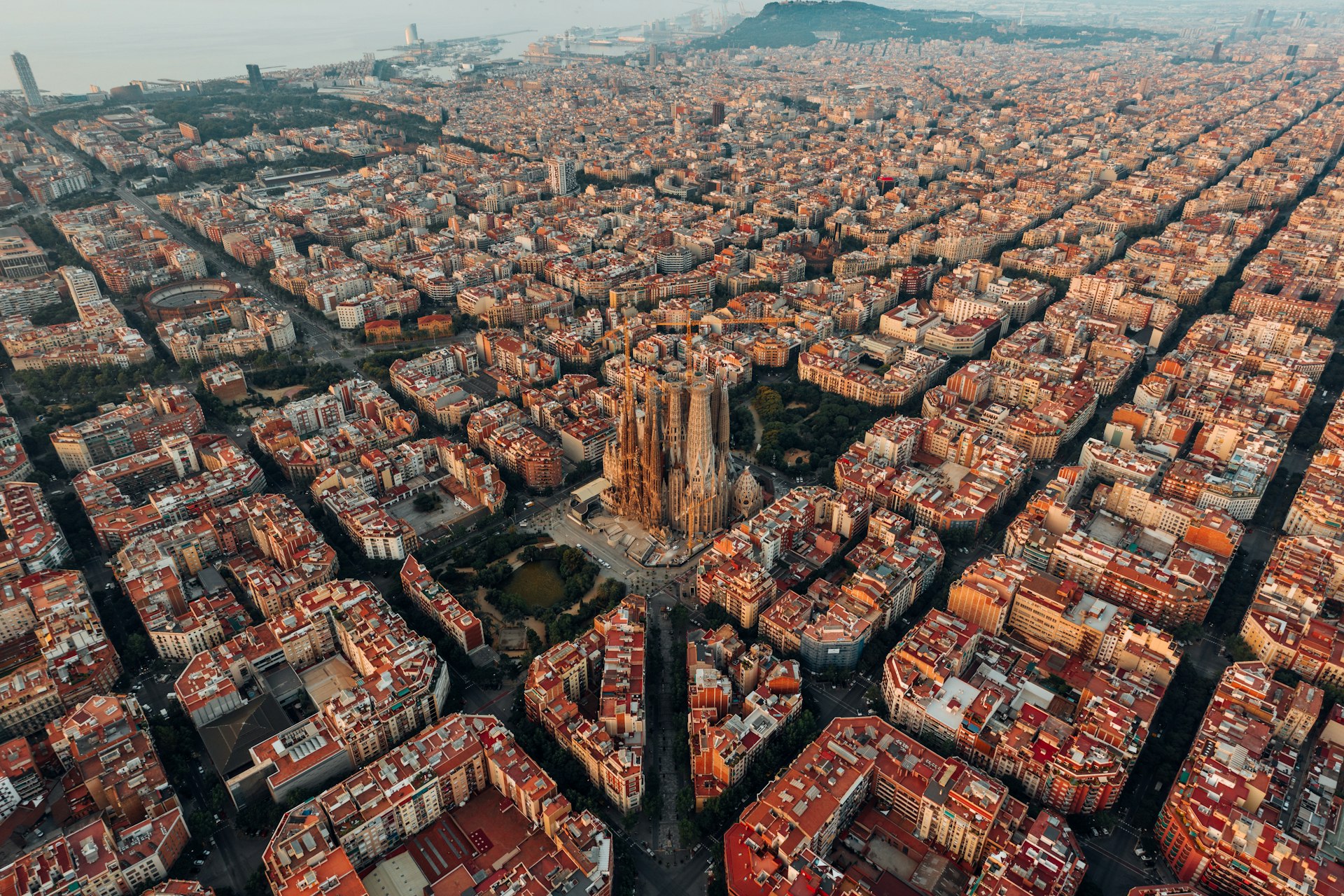
Barcelona (BCN)
Fly to Barcelona
Fares we have seen from US cities. Bag fees are shown before you pay.
The sights to plan your days around
Start with the Museu Picasso. The collection showcases practically all of the artist's early works until the Blue Period, plus a series based on Las Meninas and a collection of prints. Picasso spent his formative years in Barcelona and studied at the Acadèmia de Belles Arts, which was housed in the Llotja de Mar — now open to visitors. He also frequented the beer hall Els Quatre Gats, a meeting place for artists.[4]

The guided tour of the Picasso Museum includes skip-the-line entry and lasts 1 hour and 30 minutes. It is led by an official guide who is an expert on Picasso, and the guide tells visitors in detail about his life and work. Tours are offered in English, French, Italian or German, and the meeting point is Palau Dalmases at c/ Montcada, 20 — nearest metro L4, Jaume I. Arrive 10 minutes before departure.[4]
The museum is closed on Mondays, the first Sunday of the month, 1/1, 1/5, 24/6, 24/12, 25/12 and 31/12. English tour times change through the year: from January to March and November to December, the English tour runs Tuesday at 2.30pm and 4.30pm, Wednesday at 4.30pm, Thursday at 3pm, Friday at 4pm and Saturday and Sunday at 10am and 4pm. From April to October it runs Tuesday, Wednesday and Thursday at 12.30pm, Tuesday and Wednesday at 2.30pm and 4.30pm, and Thursday at 3pm. From 9th April to 15th November there is also an English tour Tuesday to Friday at 1.30pm. Spanish tours run Saturdays at 12.30pm, French at 2pm, Italian on Tuesdays at 4.30pm (and in August Tuesday, Wednesday, Friday and Sunday at 5pm), and German from 16th April to 29th October on Wednesdays at 4.15pm. The tour offers free cancellation.[4]
On Montjuïc, the Museu Nacional d'Art de Catalunya sits in the Palau Nacional, built for the 1929 International Exhibition. Its galleries cover art from the 10th to the 20th century, including Romanesque, Gothic, Renaissance and Baroque works, and there is a 360º viewpoint over Montjuïc and Barcelona.[2]
For modernist architecture, Casa Amatller was originally constructed in 1875 and transformed between 1898 and 1900 for chocolatier Antoni Amatller. It was designed by architect Josep Puig i Cadafalch, and visits start from €20.00, with guided tours available.[2]
Park Güell deserves more than a photo stop. The Park Güell Museu d'Història de Barcelona is an interpretation centre in the Casa del Guarda — one of the entrance pavilions — explaining the connection between Antoni Gaudí, Eusebi Güell and the modernist vision of the park. Through audiovisual resources, maps and photographs, you learn how the garden city project became one of the city's most recognisable icons. The site was originally a private housing development inspired by English garden cities, but the project was not successful and only two plots were ever sold. The Casa del Guarda was designed as the residence for the site's caretaker.[2],[3]
The museum is at Carrer d'Olot, s/n. You can reach it by Metro on line L3 to Lesseps station, or by bus routes 24, 92 and 116. In summer it is open Monday to Sunday from 09:30 to 20:00; in winter, Monday to Sunday from 09:30 to 18:30. Check all schedules on the official website before you go. The contact phone is +34 932 562 100 and the email is museuhistoria@bcn.cat.[3]
Neighborhoods worth wandering
The Born is the neighborhood to base a museum day around. The Moco Museum is housed in the 16th-century Palau Cervelló next to the Picasso Museum, and the Arxiu Fotogràfic de Barcelona — the public archive safeguarding the city's visual memory — is also in El Born.[2]
Passeig de Gràcia is where modernist architecture lines up. Casa Amatller is here, and so is the Centre d'Art Amatller, an immersive art space housed in a modernista building on the same boulevard.[2]
For a different side of the city, head to the 22@ technology district, where the Museu Can Framis occupies a restored former textile factory. The building combines the original factory structures with contemporary additions by Jordi Badia.[14]
Beyond the famous sights: smaller museums and art spaces
Barcelona's smaller museums are where a short trip gets interesting. The Banksy Museum Barcelona displays over 130 works by Banksy — life-size replicas and recreations of the artist's most iconic pieces, including murals, silkscreens, sculptures and installations. The exhibition is organised geographically and includes works from England, France, Italy and the United States, culminating in a section dedicated to Palestine and Ukraine. The works address social issues such as inequality, violence and the problems of modern society, and the permanent exhibition brings the artist's visual universe closer without compromising the anonymity that has always protected his identity.[2],[7],[8]
The Banksy Museum is at Carrer de Trafalgar, 34. You can reach it by metro lines L1 and L4 at Urquinaona station, by buses 24, 52, H12, V13, 59, 67 and 68, or by Rodalies trains R2, R2N, R2S, R11, R13, R14, R15 and R16 at Passeig de Gràcia. It is open Friday to Wednesday from 10:00 to 19:15, and on Thursdays from 10:00 to 20:15. A visit usually takes between 1 and 1.5 hours. Guided tours are offered in Catalan, Spanish, English and French.[7],[8]
The Moco Museum is a private museum that opened in Barcelona following its success in Amsterdam, with spaces also in Amsterdam and London. It is dedicated to bold, provocative modern art and displays works by Banksy, Warhol and Basquiat. The Moco Masters gallery shows artists including Warhol, Basquiat, Dalí, Haring, Hirst and Kusama, while the Moco Contemporary gallery shows original works by Murakami, Hayden Kays and David LaChapelle, among others. There are also immersive digital art exhibitions by teamlab, Les Fantômes and Studio Irma.[2],[12],[13]
The Moco Museum is at Carrer de Montcada, 25, and is reached by Metro L4 at the Jaume I stop, or by buses 17, 45, 120 and V17. It is open Monday to Sunday from 10am to 8pm, and a ticket costs €19.50, including admission to the museum and its exhibitions. Children from 0 to 9 years old get free admission, and the ticket offers free cancellation. The museum is wheelchair accessible, with an elevator and ramps letting wheelchair users and people with reduced mobility access the 16th-century Gothic building. People with a disability card and their companions get reduced-rate access, and guide dogs and accredited assistance dogs are allowed. Check all schedules on the museum's official website.[12],[13]
The Music Museum holds a collection of some 500 musical instruments, illustrated with audiovisual exhibits in English, Catalan and Spanish. It is located in the concert hall building L'Auditori, designed by architect Rafael Moneo, and a booking includes admission to the museum. Tickets bought now give access until December 2026.[2]
Other small museums worth knowing: the Museu Egipci de Barcelona holds one of Europe's most important private collections of Pharaonic Egyptian archaeology. The Fundació Suñol brings together over 1,200 key works of contemporary art from the collection of Josep Suñol Soler. The Museu Frederic Marès was created from a donation by sculptor Frederic Marès and holds an important collection of Hispanic sculpture, especially religious works spanning from Antiquity to the 19th century, alongside Marès's personal universe of medieval sculptures, everyday objects, keepsakes and unusual collections. The Museu Can Framis is dedicated to contemporary Catalan painting and holds more than 300 works created from the 1960s to the present day.[2],[11],[14]
For contemporary art, the Fundació Foto Colectania is a leading centre for contemporary Spanish photography, and the Espais Volart is a temporary exhibition centre for Catalan contemporary art spread across two modernista buildings. The Fundació Fran Daurel is a contemporary art museum in Poble Espanyol with a private collection spanning 20th- and 21st-century art through painting, sculpture and ceramics, plus a 3,500 m² outdoor sculpture garden where large-scale works can be explored.[2],[9]
A few more spaces reward a spare hour: the Reial Monestir de Santa Maria de Pedralbes is a Gothic monastic complex founded in 1327, now open to the public as a museum and cultural site. The Ideal Centre d'Arts Digitals is housed in a former cinema dating from 1917. CaixaForum occupies a former modernista textile factory and is now a cultural centre for temporary exhibitions and immersive experiences. Arts Santa Mònica is a contemporary arts centre housed in a former convent, and Palau Robert is a public venue in a neoclassical building hosting exhibitions and events about Catalonia.[2]
A day trip to Montserrat
The mountain of Montserrat is a rugged natural park with a jagged profile, one of the most distinctive and recognisable geological landscapes in Catalonia. The Museu de Montserrat is the artistic space of the Benedictine Monestir de Montserrat, with a collection encompassing painting and sculpture from the Middle Ages to the twentieth century. It displays works by El Greco, Caravaggio, Monet, Picasso and Dalí, and its rooms blend sacred art, modernity and a notable archaeological collection from the Near East assembled in the early twentieth century. The museum houses one of the most significant private collections in Catalonia, assembled thanks to the cultural efforts of the Benedictine community.[10]

There are several ways to visit. The Montserrat Tour All Included ascends Montserrat on one of the few rack railways still in operation in Catalonia, accompanied by an expert guide who takes you to visit the monastery, and gives you the chance to discover the Escolania de Montserrat, one of the oldest and most prestigious children's choirs in Europe. The Morning excursion to Montserrat spends a morning on a tour of Montserrat, and the Afternoon excursion gives you an afternoon to discover the holy mountain. The Tot Montserrat day pass lets you discover Montserrat independently from Barcelona, traveling by metro and train and reaching Montserrat by Rack Railway or Aeri cable car, with lunch in Montserrat included.[10]
Getting around
Barcelona's metro and bus network reaches most of the sights on this list. Useful stops: L3 to Lesseps for Park Güell, L4 to Jaume I for the Picasso Museum meeting point, L1 and L4 at Urquinaona for the Banksy Museum, and L1 at Glòries for the Museu Can Framis. Buses fill the gaps — routes 24, 92 and 116 for Park Güell; 47, 120, V15 and V17 for the Picasso tour meeting point; 17, 45, 120 and V17 for the Moco; 7, 192 and H12 for Can Framis; and tram line T4 stops at Ca l'Aranyó near Can Framis.[3],[4],[7],[13],[14]

If you plan to move around a lot, the Barcelona Card's transport option may simplify things. It includes unlimited public transport for 48, 72, 96 or 120 hours, and with the transport included option it covers the train and/or metro to Barcelona Airport.[7],[11]
For questions on the ground, official Tourist Information Points answer visitors' questions and point them in the right direction. You can filter them by district — including Ciutat Vella, Horta-Guinardó, Nou Barris, Sant Andreu, Sant Martí, Sants-Montjuïc and Sarrià-Sant Gervasi — and by accessibility features. Tourist telephone assistance is available 7 days a week, Monday to Sunday, 8am–8pm.[6]
Saving money: is the Barcelona Card worth it?
The Barcelona Card includes admission to the city's museums, monuments and attractions — more than 25 free museums and cultural venues — and offers a range of special discounts, with more than 70 discounts on tours, leisure activities, shows and other services. It also gives a 10% online purchase discount. You can add unlimited public transport for 48, 72, 96 or 120 hours, including the train and/or metro to Barcelona Airport with the transport included option.[1],[7]

There is also a Barcelona Card Modernista, which gives access to ten landmark buildings with no queues and complete flexibility on a single card. If your trip is architecture-focused, compare that against the standard card before buying.[5]
Questions people ask
Do I need to book Barcelona museums in advance?
For popular sites and guided tours, booking ahead is sensible — the Picasso Museum guided tour includes skip-the-line entry and has set departure times through the week. The Moco Museum ticket offers free cancellation, so you can book early and change plans if needed. Always check the official website for current opening hours before you go.[3],[4],[13]
Which museums are best for a rainy day in Barcelona?
The Picasso Museum, the MNAC on Montjuïc, the Moco Museum and the Museu Egipci de Barcelona all work well indoors. The Music Museum is another good option, with audiovisual exhibits in English, Catalan and Spanish. Note that the Picasso Museum is closed on Mondays, the first Sunday of the month and several public holidays.[2],[4],[12]
Is the Banksy Museum wheelchair accessible?
No — the museum is not accessible for wheelchair users because the upper floors do not have adapted access, and the three floors are connected only by stairs with no elevator. The entrance is accessible, there is an adapted restroom, and staff can use a portable ramp at the shop exit step. Admission is free for people with disabilities and accredited companions, and you can call 935 156 863 or email info@museobanksy.es with accessibility questions.[2],[7]
How much does the Moco Museum cost, and is it accessible?
A ticket costs €19.50 and includes admission to the museum and its exhibitions. Children from 0 to 9 get in free, and the ticket offers free cancellation. The museum is wheelchair accessible, with an elevator and ramps, and people with a disability card and their companions get reduced-rate access.[12],[13]
What is the best way to see Montserrat from Barcelona?
You have three main options: the Montserrat Tour All Included, which ascends by rack railway with an expert guide and a visit to the monastery; the Morning or Afternoon excursions, which give you a half-day on the mountain; or the Tot Montserrat day pass, which lets you travel independently by metro and train and reach Montserrat by Rack Railway or Aeri cable car, with lunch included.[10]
Where can I get tourist information in Barcelona?
Official Tourist Information Points answer questions and point you in the right direction, and you can filter them by district and by accessibility features. Tourist telephone assistance runs 7 days a week, Monday to Sunday, 8am–8pm.[6]
Where this comes from
Every rule, fee and deadline above is taken from these official pages, which we read on October 30, 2026. Rules change, so check the official page before you apply or pay.
- [1]Barcelona Tourism, Official Website | This is Barcelona · Turisme de Barcelona
- [2]Museums and exhibitions | This is Barcelona · Turisme de Barcelona
- [3]Park Güell. Museu d'Història de Barcelona · Turisme de Barcelona
- [4]Picasso Museum: Admission and Guided Tour · Turisme de Barcelona
- [5]Itineraries | This is Barcelona · Turisme de Barcelona
- [6]Official Tourist Information Points | This is Barcelona · Turisme de Barcelona
- [7]Museu Banksy · Turisme de Barcelona
- [8]Banksy Museum tickets: street art · Turisme de Barcelona
- [9]Fundació Fran Daurel · Turisme de Barcelona
- [10]Museu de Montserrat · Turisme de Barcelona
- [11]Museu Frederic Marès · Turisme de Barcelona
- [12]Museu Moco · Turisme de Barcelona
- [13]Moco Museum Barcelona: Modern & Contemporary Art | Tickets | This is Barcelona Tickets · Turisme de Barcelona
- [14]Museu Can Framis. Fundació Vila Casas · Turisme de Barcelona
Was this guide helpful?
Comments
Been through this recently? Share what happened, a tip, or a question for other travelers.
No comments yet. Be the first to share your experience.